
Proverbs 3:5-6 NIV
Trust in the Lord with all your heart and lean not on your own understanding; in all your ways submit to him, and he will make your paths straight.
In a world that prizes self-sufficiency and personal control, there’s a profound challenge embedded in two simple verses from Proverbs: “Trust in the Lord with all your heart. Do not depend on your own understanding. Seek His will in all you do and he will show you which path to take” (Proverbs 3:5-6).
These words roll off the tongue easily. We quote them, sing them, and share them with friends facing difficult seasons. But when life knocks our cup of faith around—when sickness invades, finances crumble, or relationships fracture—do our lives actually reflect the trust we so readily proclaim?
More Than a Spiritual Cliché
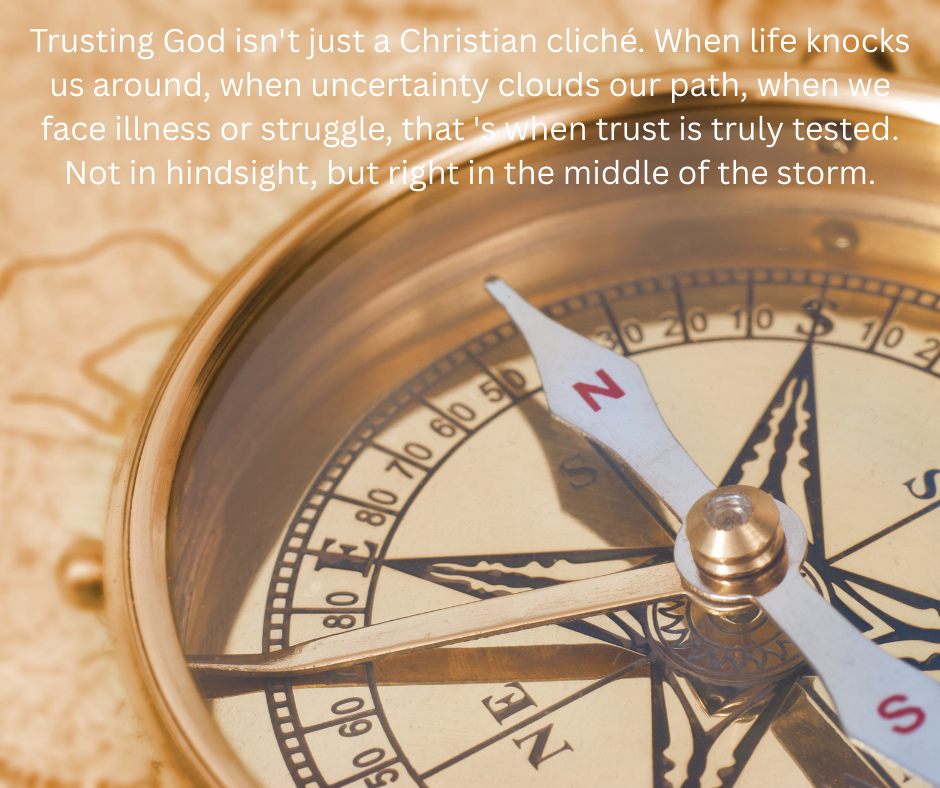
Trust can become dangerously cliched among believers. It’s easy to talk about trust from a position of comfort, but the true test comes in the middle of the storm, not after we’ve safely reached the shore and can look back with the clarity of hindsight.
Everything around us is designed to make us self-sufficient. We live in an age where we have access to nearly everything we need at our fingertips. Yet God calls us to trust Him completely—not just when we’re lacking, but especially when we think we have it all figured out.
The wisdom of Proverbs isn’t a collection of spiritual life hacks or ironclad formulas that make God predictable. Consider Proverbs 22:6: “Train up a child in the way he should go, and when he is old, he will not depart from it.” Many faithful parents have raised their children in godly ways, yet watched them walk away. This isn’t a failure of the proverb—it’s a reminder that these verses invite us to walk in God’s ways while trusting Him with the outcomes.
The Foundation: Who We Trust
Before we can trust properly, we must understand who we’re trusting. Isaiah 40 paints a breathtaking picture: God holds the oceans in His hands, measures the heavens with His fingers, knows the weight of the earth. He sits above the circle of the earth where people seem like grasshoppers. He brings out the stars like an army, calling each by name, and not a single one is missing.
This is the Lord we’re called to trust—the everlasting God, Creator of all the earth.
C.S. Lewis captured it perfectly: “In God you come up against something which is in every respect immeasurably superior to yourself. Unless you know God as that and therefore know yourself as nothing in comparison, you do not know God at all.”
Trust in the Lord serves three vital purposes in the Christian life: it’s the foundation of everything we are and do, it shapes our entire journey, and it breaks down any illusion that we’re self-sufficient or self-determining.
Our trust isn’t ultimately in God’s promises—it’s in the God of the promises. This distinction matters profoundly.
The Practice: How We Trust
We obey even when it makes no sense. The Hebrew word for “trust” in Proverbs 3:5 carries the imagery of lying face down, helpless—like a servant waiting for the master’s command or a defeated soldier surrendering to a conquering general. This is total surrender.
Moses experienced this when God called him to lead Israel out of Egypt. His response? “Send someone else.” But God insisted: you’re plan A, plan B, and plan C. Moses obeyed even when it made no sense.
Where in your life are you delaying obedience because you’re waiting for it to make sense first? Are you negotiating with God when His word is already abundantly clear?
We refuse to depend on our own understanding, especially during uncertainty. Jeremiah 10:23 states bluntly: “I know, Lord, that our lives are not our own. We are not able to plan our own course.” The Lord knows all human plans, and He knows they are futile (Psalm 94:11).
Think of it like this: When Airbus jets were recently grounded because their navigation software failed, pilots had no choice but to stop trusting their own panels and wait for higher guidance. That’s exactly what spiritual trust looks like—when your internal systems flash warnings, you don’t panic. You pause, stop depending on your own readings, and lean hard on the only One whose guidance never fails.
We bring God into every decision. This doesn’t mean we stop thinking or planning. It means we refuse to make decisions with ourselves at the center. As Colossians 3:17 instructs: “Whatever you do or say, do it as a representative of the Lord Jesus.”
How do we know God’s will? Here’s the key: the more confident you are about God’s Word, the clearer you will be about God’s will. If Scripture is in you, shaping your instincts and saturating your thinking, you won’t be guessing His will—you’ll know what to do, how, and when.
The Promise: What Happens When We Trust
When we trust God with all our heart and seek His will in all we do, He promises to show us which path to take. But let’s be clear—a straight path doesn’t mean an easy one. God making your path straight doesn’t guarantee smooth sailing; it means clarity of direction even when the journey is difficult.
Isaiah 30:21 offers this beautiful promise: “Your own ears will hear him, and right behind you a voice will say, ‘This is the way you should go, whether to the right or to the left.'”
If your path feels confused or unclear, it’s not because God hasn’t shown you—it’s that He has shown you, and you haven’t trusted that path. His path becomes clear not when we complete a checklist of spiritual tasks, but when we sincerely (albeit imperfectly) desire to trust Him with all our heart.
Psalm 37:23-24 says it best: “The Lord directs the steps of the godly. He delights in every detail of their lives. Though they stumble, they will never fall, for the Lord holds them by the hand.”
Walking the Path
Consider Abraham, who “when called to go to a place he would later receive as his inheritance, obeyed and went, even though he did not know where he was going” (Hebrews 11:8). Was he reckless? Absolutely not. He trusted the Lord.
When life feels complex, foggy, and overwhelming, our greatest need isn’t a detailed roadmap. It’s the confidence that God has us even when we can’t see the road ahead.
What are you carrying today that you need to hand over to renew your trust in the Lord? What are you being self-sufficient with? Without trust in the Lord, we slip into being worried, anxious, self-trusting Christians who are ultimately ineffective in His mission.
God’s path is one that leads from Him and to Him. It’s a path that exalts Christ, says no to sin and yes to purity, aligns with God’s character, and produces the fruit of the Spirit. It’s a path you’ll know you’re on because you’ll have the inward peace of the Spirit, and it’s laid out in vivid clarity in His Word.
For every decision you need to make, every trial you face, every struggle ahead—you will find wisdom not in your own understanding, but in the Word of God. Trusting Him will help you see His path.
You’ll know you’re truly trusting in the Lord when His will and His Word get the final say over everything you do—and you trust Him for the outcome.