
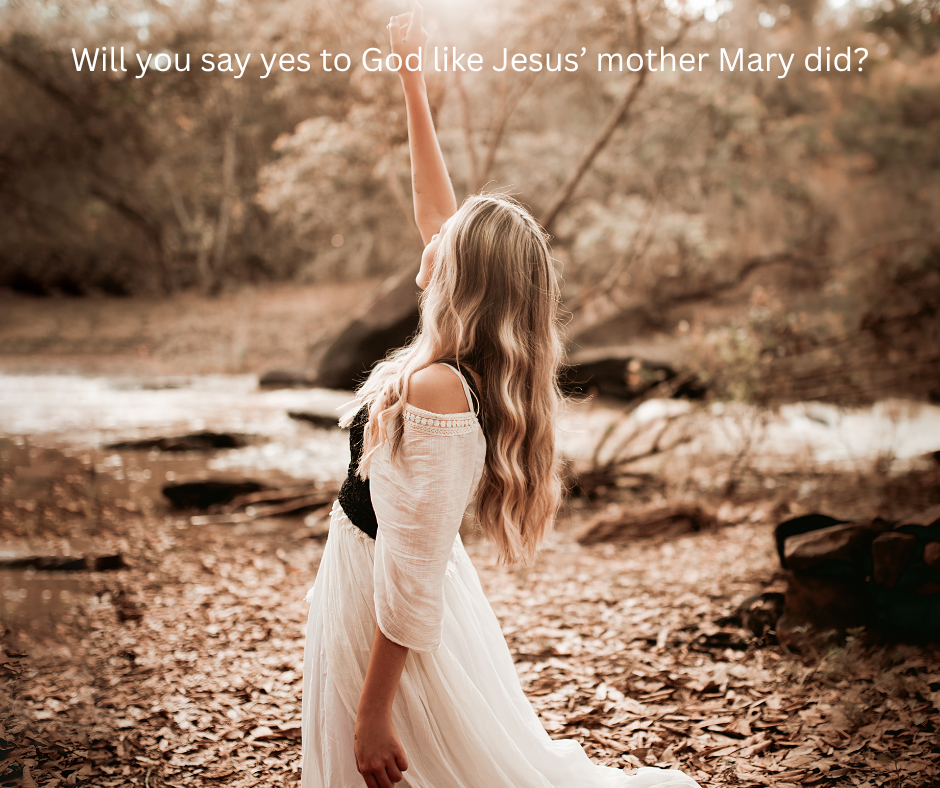
Luke 1:26-38 NLT
The Birth of Jesus Foretold
26 In the sixth month of Elizabeth’s pregnancy, God sent the angel Gabriel to Nazareth, a village in Galilee, 27 to a virgin named Mary. She was engaged to be married to a man named Joseph, a descendant of King David. 28 Gabriel appeared to her and said, “Greetings, favored woman! The Lord is with you! 29 Confused and disturbed, Mary tried to think what the angel could mean. 30 “Don’t be afraid, Mary,” the angel told her, “for you have found favor with God! 31 You will conceive and give birth to a son, and you will name him Jesus. 32 He will be very great and will be called the Son of the Most High. The Lord God will give him the throne of his ancestor David. 33 And he will reign over Israel forever; his Kingdom will never end!” 34 Mary asked the angel, “But how can this happen? I am a virgin.” 35 The angel replied, “The Holy Spirit will come upon you, and the power of the Most High will overshadow you. So the baby to be born will be holy, and he will be called the Son of God. 36 What’s more, your relative Elizabeth has become pregnant in her old age! People used to say she was barren, but she has conceived a son and is now in her sixth month. 37 For the word of God will never fail.” 38 Mary responded, “I am the Lord’s servant. May everything you have said about me come true.” And then the angel left her
In a world that constantly demands our attention and energy, one question cuts through the noise with startling clarity: Will you say yes to God?
This isn’t a theoretical question posed in the abstract. It’s a deeply personal invitation that echoes through Scripture and resonates in the lives of faithful people across generations and continents. When we examine the biblical narrative, we discover that God’s kingdom work isn’t a quick fix—it’s a lifelong, intergenerational, spirit-led construction project that invites our participation.
Co-Workers in God’s Service
The apostle Paul offers us a profound framework for understanding our role in God’s mission. Writing to the church in Corinth, he declares: “For we are co-workers in God’s service. You are God’s field, God’s building. By the grace God has given me, I laid a foundation as a wise builder. And someone else is building on it. But each one should build with care. For no one can lay any foundation other than the one already laid, which is Christ Jesus” (1 Corinthians 3:9-11).
Notice the beautiful tension in these words. We are co-workers with God—not independent contractors, not passive observers, but active participants in something far greater than ourselves. Yet we build on a foundation already established by Christ. Our creativity, our effort, our dedication matter enormously, but they flow from a secure foundation we didn’t create.
This perspective transforms how we approach mission and service. We’re not building something from scratch, hoping it will stand. We’re joining a construction project already underway, led by the Master Builder himself.
Mary’s Revolutionary Yes
Perhaps no one in Scripture embodies the power of saying yes to God quite like Mary, the mother of Jesus. Her story takes us through four significant locations—Nazareth, Bethlehem, Egypt, and Jerusalem—each representing a different dimension of her faithful obedience.
When the angel Gabriel appeared to Mary in Nazareth, she was a young teenage girl, engaged to be married, living an ordinary life. The announcement that she would conceive and bear the Son of God was nothing short of world-shattering. Scripture tells us she was “confused and disturbed,” trying to understand what the angel could mean.
Mary’s question was honest and practical: “How can this happen? I’m a virgin.” But when the angel explained that the Holy Spirit would accomplish this miracle, Mary’s response became one of the most powerful statements of faith in all of Scripture: “I am the Lord’s servant. May everything you have said about me come true” (Luke 1:38).
In one word, Mary said yes.
She turned her fear into faith. She transformed her panic into peace. She became filled with divine grace and joy. And her yes changed everything—not just for her, but for all of humanity.
The Song of a Surrendered Heart
What’s remarkable about Mary’s response is that she didn’t just acquiesce reluctantly. She worshiped. Her song, known as the Magnificat, reveals a young woman deeply versed in Scripture, quoting from Genesis, Job, and the Psalms as she praises God:
“Oh, how my soul praises the Lord. How my spirit rejoices in God my Savior. For he took notice of his lowly servant girl. And from now on all generations will call me blessed. For the mighty one is holy and he has done great things for me. He shows mercy from generation to generation to all who fear him” (Luke 1:46-50).
Mary’s yes wasn’t passive submission—it was active worship. She saw beyond her circumstances to the character of God. She recognized that being chosen for this mission was both terrifying and glorious, costly and precious.
The Ripple Effect of Obedience
Mary’s yes had a profound ripple effect on those around her. Her faithfulness created opportunities for others to say yes to God as well.
Joseph said yes when he chose to believe the angel’s message and stay with Mary, supporting her through scandal and uncertainty. Elizabeth said yes when she welcomed Mary into her home and encouraged her in God’s calling. Simeon and Anna said yes when they publicly affirmed and vindicated Mary and Joseph, giving thanks to God for what He was doing through them.
Even at the cross, standing near Jesus in his final moments, Mary’s presence created an opportunity for the disciple John to say yes—to take Mary into his home and care for her as his own mother.
This is the beautiful mystery of faithful obedience: when we say yes to God, we don’t just change our own trajectory. We create space for others to encounter God’s call in their lives. We become part of a chain reaction of faith that extends far beyond what we can see or imagine.
Three Responses, One Choice
When God calls us to join His mission—whether through prayer, giving, or going—we essentially have three options:
Yes. We can embrace the invitation with faith and courage, trusting that God will equip us for whatever He calls us to do.
No. We can explicitly reject God’s call, choosing our own path instead of His.
Nothing. We can do nothing—perhaps the most common and dangerous response of all. We can hear the call, feel momentarily stirred, and then return to business as usual, allowing the moment to pass without action.
The easiest thing to do when challenged by God’s Word is simply nothing. We can nod in agreement, feel appropriately moved, and then walk away unchanged. But this passive non-response is still a response—it’s a quiet no disguised as indecision.
Building With Care
Around the world today, ordinary people are saying extraordinary yeses to God. Missionaries are serving in difficult places, building relationships, developing technology for special needs communities, teaching students, and planting seeds of the gospel in hard soil. They count it a privilege to live and serve where God has placed them.
These modern-day Marys remind us that God’s kingdom work continues. The foundation of Christ stands firm, and we’re invited to build upon it with care, humility, hope, and holy imagination.
Your Yes Matters
Your yes will look different from anyone else’s. It’s uniquely shaped by your gifts, your circumstances, your resources, and God’s specific call on your life. But make no mistake—your yes matters.
Will you say yes to God? Not tomorrow, not someday, but today?
The question stands before each of us, as clear and compelling as it was for Mary in Nazareth, for Joseph in his uncertainty, for disciples at the cross, and for missionaries serving across the globe.
Yes.
That’s the one word that changes everything.
This resource is produced using original content from our Sunday Service with the assistance of AI.