
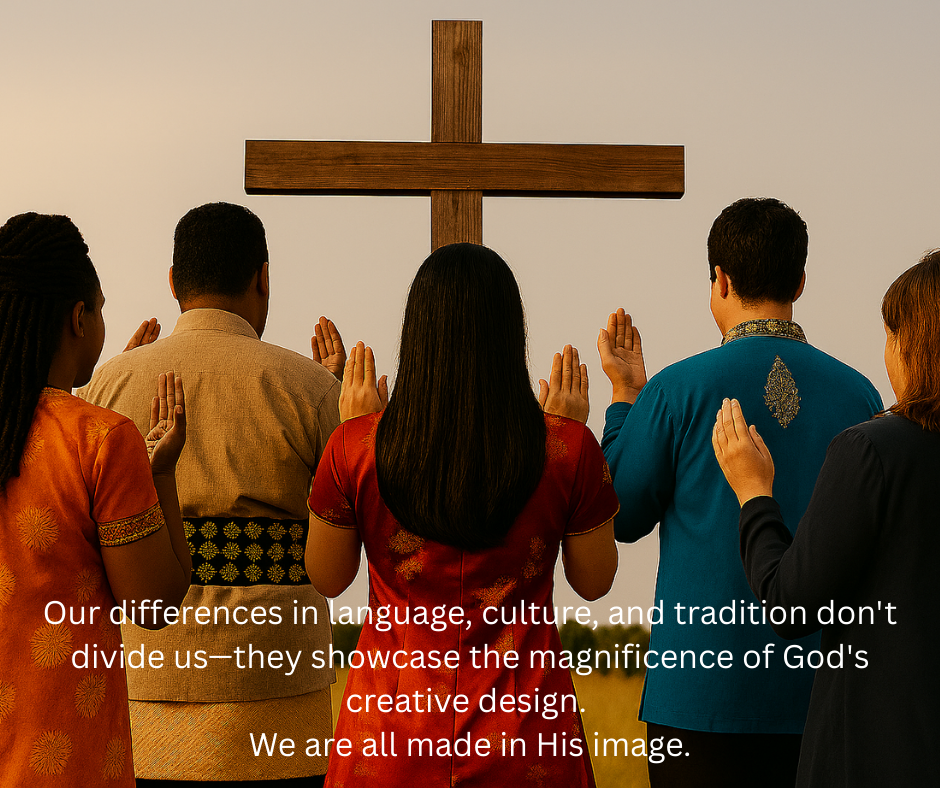
Galatians 3:26-28 – “In Christ Jesus you are all children of God through faith… There is neither Jew nor Gentile, neither slave nor free, nor is there male or female, for you are all one in Christ Jesus.”
Colossians 3:11 – “Here there is no Gentile or Jew, circumcised or uncircumcised, barbarian or Scythian, slave or free, but Christ is all and in all.”
1 Corinthians 12:12-14 – “For as the body is one and has many members… For by one spirit we are all baptized into one body, whether Jews or Greeks, whether slaves or free.”
Revelation 7:9 – “After this I looked, and there before me was a great multitude that no one could count from every nation, tribe, people, and language, standing before the throne and before the Lamb.”
We Are One: Celebrating Unity in Christ Through Cultural Diversity
Standing before God’s throne, imagine a scene so magnificent that it defies human counting—people from every nation, tribe, and tongue, united in worship. This isn’t just a distant future hope; it’s a reality we can begin experiencing today within the body of Christ.
The Divine Design of Diversity
From the very beginning, humanity was created in God’s image. Genesis 1:27 reminds us that God made mankind—both male and female—in His own likeness. This foundational truth establishes that regardless of our external differences, we all bear the divine imprint of our Creator.
Initially, there was one race, one language, one people. But at the Tower of Babel, God confused human language and scattered people across the earth. What might seem like divine disruption was actually part of a greater plan. From this scattering emerged the beautiful tapestry of human diversity—different languages, cultures, customs, and expressions of life.
Yet here’s the remarkable truth: what was divided at Babel is reunited in Christ.
No Distinctions in the Kingdom
The apostle Paul made revolutionary declarations that challenged the social structures of his time—and ours. In Galatians 3:28, he proclaimed: “There is neither Jew nor Gentile, neither slave nor free, nor is there male or female, for you are all one in Christ Jesus.”
This wasn’t mere theological theory. Paul was addressing real divisions that threatened to fragment the early church.
First, there is no distinction of race. God called Abraham and his descendants, entrusting them with His revelation. But when Christ came, God’s promise extended to all families of the earth. Every nation, every race, every color, every language—all are equal in their need for salvation, equal in their inability to earn it, and equal in God’s offer of it freely through Jesus Christ.
Second, there is no distinction of rank. Throughout history, societies have created class systems and caste hierarchies based on birth, wealth, or education. But in Christ, these distinctions are prohibited. The slave and the master find common ground at the foot of the cross. The wealthy and the poor kneel side by side in worship.
Third, there is no distinction of sex. In a world where women were often despised, exploited, and marginalized, Paul’s assertion that male and female are one and equal in Christ was nothing short of revolutionary.
Unity Doesn’t Mean Uniformity
Here’s an important clarification: when we say Christ abolished distinctions, we’re not saying differences don’t exist. Walk outside and you’ll immediately see diversity everywhere. Rather, these differences no longer create barriers in our fellowship within the body of Christ.
Consider how different cultures worship the same Lord:
In Nigerian churches, worship is divided into two sacred sections—worship and praise. The worship session features slow songs with raised hands, magnifying the Lord. Then comes the praise section, a joyful celebration with every available instrument, singing, clapping, dancing, and sometimes even rolling on the floor to express gratitude to God. Twenty minutes of pure, uninhibited praise isn’t uncommon.
In Chinese culture, two New Years are celebrated. The Western New Year on January 1st involves family time and preparation. But the lunar New Year in February is the grand celebration, with families traveling from across the country to reunite. An intriguing custom involves placing red paper strips with Chinese characters around doorframes—a practice some believe connects to the Passover event in Exodus 12:7, when blood was placed on doorframes for protection.
In Tongan tradition, blessings are spoken with deep reverence, invoking the Lord’s face to shine upon His people and grant them peace.
These different expressions of faith don’t divide us—they enrich the global body of Christ. We honor God when we embrace the beautiful differences He has given us as His children.
The Heavenly Vision
Revelation 7:9 paints the ultimate picture of unity in diversity: “After this I looked, and there before me was a great multitude that no one could count, from every nation, tribe, people and language, standing before the throne and before the Lamb. They were wearing white robes and were holding palm branches in their hands.”
Notice that in heaven, diversity isn’t eliminated—it’s celebrated. People from every background stand together, unified not by cultural uniformity but by their common worship of Jesus Christ. They stand in reverence and awe before the throne, their differences not erased but transcended by their shared devotion.
Living Out This Unity Today
This heavenly reality should shape our earthly communities. When we gather as believers, we’re experiencing a foretaste of that great multitude. Whether in a small rural church or a multicultural congregation representing thirteen nations, the principle remains the same: in Christ, we are one body, one people.
This unity isn’t optional—it’s essential to the gospel itself. If we’re not expressing equality and unity in our fellowship, we’re not being faithful to the message of Christ. Before God, we are all accepted on the same basis: faith in Jesus.
We must resist the temptation to despise one another, to rank one another, to look down on or patronize anyone. The racial prejudices, class divisions, and gender discrimination that matter so much in the world are abolished in the body of Christ.
A Call to Celebrate
As we move forward, let’s remember that we’ve put off the old nature with its distinctions, injustices, and divisions. We’ve put on the new nature of Christ—a nature that sees brothers and sisters rather than strangers, that celebrates diversity rather than fearing it, that builds bridges rather than walls.
The spiritual revolution of Christian unity transforms how we see each other. No longer do external differences define our relationships. Instead, we recognize the image of God in every face, the work of Christ in every heart that belongs to Him, and the presence of the Holy Spirit in every believer.
This is the beautiful reality of the kingdom of God—unity without uniformity, diversity without division, and a love that transcends every human barrier. May we live as citizens of this kingdom today, anticipating that great gathering when every nation, tribe, people, and language will stand together before the throne.
In Christ, we are one. Hallelujah.